

 English
  русский
  Español
  عربى
عربى 
Electric Linear Actuators for Adjustable Desks: How They Work and What to Specify
2026-03-22
When someone adjusts an electric standing desk, the mechanism doing the actual work is a linear actuator inside each leg column. It's not the most visible component — it's hidden inside the telescoping steel tube — but it determines the desk's speed, load capacity, noise level, lifespan, and how reliably the desk stays at the height you set it. Understanding how linear actuators work and what separates a quality unit from a cheap one is useful both for evaluating complete desks and for specifying standalone actuators for furniture, equipment, or automation applications.
What a Linear Actuator Does and How It Does It
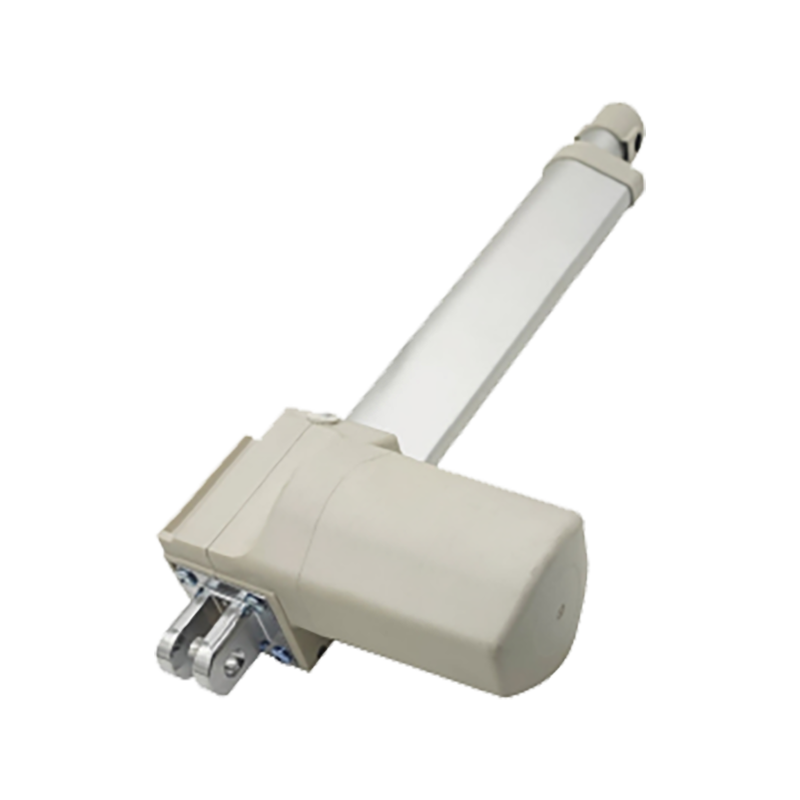
A linear actuator converts rotational motor motion into linear (straight-line) motion. In a desk leg column, this means the motor's spinning shaft is converted into the extending and retracting movement that raises and lowers the desk surface.
The conversion mechanism in most electric desk actuators is a lead screw drive. The motor drives a lead screw — a threaded rod — that turns inside a nut fixed to the outer tube of the leg column. As the screw turns, the nut (and the outer tube attached to it) travels along the screw, extending or retracting the column. The thread pitch of the lead screw determines the relationship between motor rotational speed and linear travel speed: a finer pitch gives more force for a given motor torque but slower travel; a coarser pitch gives faster travel but less mechanical advantage.
Some higher-end actuators use a ball screw rather than a plain lead screw. Ball screws replace the sliding contact between the screw thread and nut with rolling contact via small steel balls, which dramatically reduces friction. The result is higher efficiency (less motor energy wasted as heat), smoother operation, less wear, and longer service life. Ball screw actuators are more expensive to manufacture and are typically found in premium desk frames and industrial automation applications rather than budget desk products.
Key Specifications Explained
Stroke Length
Stroke is the distance the actuator extends from its fully retracted position to its fully extended position. In a desk context, this corresponds to the desk's height adjustment range. A stroke of 400–500mm is typical for standard adult height-adjustable desks, giving a desk height range of approximately 700–1200mm from floor to desktop surface (the exact range depends on the leg column starting height). Desks marketed for both seated and standing use by a wide range of users need at least 400mm of stroke to accommodate height differences across adults.
Load Capacity (Force Rating)
This is the maximum weight the actuator can push or pull. For desk applications, the relevant load is the combined weight of the desk surface, monitor(s), computer equipment, and anything else on the desk. Load ratings for desk actuators typically range from 500N to 1500N (50kg to 150kg) per actuator, with the desk using two actuators (one per leg) and citing the combined rating.
The important distinction is between static load capacity (what the actuator can hold without moving) and dynamic load capacity (what it can move). Dynamic capacity is always lower than static capacity. A desk frame rated for 100kg total should be understood as 100kg dynamic — the weight it can actually raise and lower, not just support at rest. Most quality desks are rated conservatively, so staying well within the rated capacity is good practice.
Speed
Travel speed for desk actuators is typically expressed in mm/second and ranges from about 20mm/s for slower budget units to 40mm/s for faster premium models. At 20mm/s, a 400mm full-range adjustment takes 20 seconds — noticeable but acceptable. At 40mm/s, the same adjustment takes 10 seconds. The difference is most relevant for people who change desk height frequently throughout the day; for occasional adjusters, either speed is fine.
Speed and force are inversely related for a given motor — faster travel requires either a more powerful motor or reduced load capacity. Desks that claim very fast speed at high load capacity are either using larger motors (which increases cost and weight) or are optimistic about the ratings. When evaluating specifications, a speed-load combination that seems unusually good compared to similar products deserves closer scrutiny.
Noise Level
Actuator noise in electric desks comes from the motor, the gearbox, and the mechanical contact between the lead screw and nut. Manufacturers typically measure and report noise at a certain distance from the desk during adjustment. Ratings under 50 dB are generally described as "quiet" — about the noise level of a normal conversation. 55–60 dB is noticeably audible in a quiet space. Over 65 dB starts to become disruptive.
The main factor affecting noise is build quality — precision manufacturing tolerances in the gearbox and lead screw assembly, and the quality of the motor's bearings. Cheap actuators with wider manufacturing tolerances vibrate more and are louder. Ball screw actuators are inherently quieter than lead screw types because rolling contact generates less noise than sliding contact.
IP Rating (Dust and Water Resistance)
For desk applications in standard office environments, IP rating isn't usually a concern — the actuators are inside enclosed leg columns and aren't exposed to moisture. For actuators used in outdoor furniture, industrial environments, medical equipment, or anywhere with moisture exposure, the IP rating matters significantly. IP54 provides protection against dust and splashing water; IP65 provides full dust protection and protection against water jets. Specifying the right IP rating for the environment the actuator will operate in is essential for outdoor and industrial applications.
Single-Motor vs Dual-Motor Desk Frames
A single-motor desk frame uses one actuator centrally positioned in the frame, with mechanical linkages transmitting the motion to the two leg columns. A dual-motor frame has an independent actuator in each leg column, running in synchronised pairs.
Dual-motor frames are a better design for height-adjustable desk applications. The independent actuators in each leg eliminate the mechanical stress that central single-motor designs transmit through the linkage system. Dual-motor frames are also more stable under asymmetric loads (equipment positioned toward one side of the desk), and the independent leg motors can be programmed with anti-collision protection that stops the desk if one leg encounters an obstruction while the other continues. This safety feature is important in offices where chairs, cables, or people could end up in the path of a lowering desk.
Single-motor frames are lighter and cheaper. For smaller desks with light loads used by a single person in a clear space, the cost savings are real, and the limitations are rarely encountered. For larger or heavily equipped desks, shared workstations, or any installation where reliability and safety over years of use matter, dual-motor is the appropriate specification.
What Differentiates Quality Actuators from Budget Units
The visible specifications — stroke, speed, load — are easy to copy on a datasheet regardless of actual quality. The factors that differentiate actuators that perform well for years from those that start having problems at 18 months aren't visible from the outside.
Motor quality is the starting point. Higher-quality motors use better-grade permanent magnets, tighter winding tolerances, and sealed bearings that maintain performance over many thousands of operating cycles. Budget motors use cheaper magnets that degrade faster and bearings that develop play over time, which manifests as increasing noise and eventually inconsistent travel speed.
Gearbox precision determines noise level and long-term consistency. A well-machined gearbox with tight tolerances between gear teeth runs quietly and maintains its gear mesh over time. A poorly machined gearbox starts with acceptable noise and gets louder as the gear teeth wear and backlash increases.
Limit switches — the sensors that stop the actuator at the ends of its stroke — need to be reliable over many thousands of cycles. In desks, the actuator reaches its end-of-stroke position regularly, and the limit switch stops the motor cleanly. A limit switch that drifts or fails causes the actuator to overrun its designed range, which stresses the mechanical components and eventually causes failure. Quality actuators use robust limit switch mechanisms with generous cycle-count ratings; budget units sometimes use minimal switches that are rated for far fewer cycles than the actuator's expected operating life.
Frequently Asked Questions
How many cycles is an electric desk actuator rated for?
Quality desk actuators are typically rated for 10,000–20,000 full cycles (one cycle being the actuator extending and retracting through its full range). At 10 full adjustments per day — which is a generous usage assumption — 10,000 cycles is about 2.7 years, and 20,000 cycles is about 5.5 years. Most desk users adjust height fewer than 10 times per day on average, so actual service life is typically longer than the cycle count implies. The actuator's actual lifespan also depends heavily on operating load — running a desk near its maximum rated load reduces component life faster than operating at 50–60% of rated capacity.
What causes an electric desk to become noisy over time?
Increasing noise in an electric desk actuator over time usually indicates wear in the gearbox or lead screw assembly. As gear teeth wear and clearances increase, the meshing contact becomes louder. Lead screw wear increases the play between the screw and nut, which creates a rattling sound during direction changes. These wear processes are normal for lead screw actuators and progress at a rate determined by the initial manufacturing quality and the operating loads. In some cases, lubricant in the gearbox dries out or migrates over time and can be replenished; in others, the wear is mechanical, and the actuator eventually needs replacement. A desk that was quiet for 3–4 years and then starts developing noise is reaching the end of its actuator service life.
Can electric linear actuators be used in applications other than desks?
Absolutely — electric linear actuators are used across a wide range of furniture and equipment applications. In furniture: reclining chairs and sofas, adjustable beds, TV lift mechanisms, and adjustable kitchen counters. In medical equipment: patient beds, examination tables, and rehabilitation equipment. In industrial and commercial applications: automated assembly equipment, agricultural machinery, solar panel positioning, access hatches and covers. The same fundamental mechanism — motor driving a lead screw to produce linear motion — scales from small actuators in furniture to large-force industrial actuators handling hundreds of kilograms. The selection criteria (stroke, force, speed, duty cycle, IP rating, control interface) are the same across applications; the values change based on what's needed.
Electric Linear Actuators | Electric Height-Adjustable Desk | Gas Springs | Get a Quote

- Contact Info
-
-
 Phone+86-15950656125
 -
 Email
Email -
 AddressRoom 1007-1, South Building, Suyue Plaza, Suzhou Industrial Park, Suzhou City, Jiangsu Province, China
-
- Products
- Follow Us
- Need help? Please contact us
Copyright ©
SuZhou Skyhone Intelligent Technology Co., Ltd.
All Rights Reserved.
Privacy
Custom Ergonomic Adjustable Office Tables Manufacturers

