

 English
  русский
  Español
  عربى
عربى 
Electric vs Pneumatic Standing Desk: Which One Should You Buy?
2026-03-08
When most people picture a height-adjustable desk, they picture the electric version — a frame with motors that raise the desktop up and down while you hold a button. But pneumatic height-adjustable desks exist too, and for certain situations they're the better option. The two technologies have different strengths, different failure modes, and different price points that matter depending on how and where the desk will be used.
How Each One Works
An electric height-adjustable table uses one or more motors — typically one per leg column, with two-motor frames being the standard in quality products — to drive lead screws or spindles that extend or retract the leg columns. The motors are activated by a control panel with up/down buttons and, on most contemporary models, a digital height display and programmable presets for your preferred sitting and standing heights. The whole mechanism runs on AC power from a wall outlet.
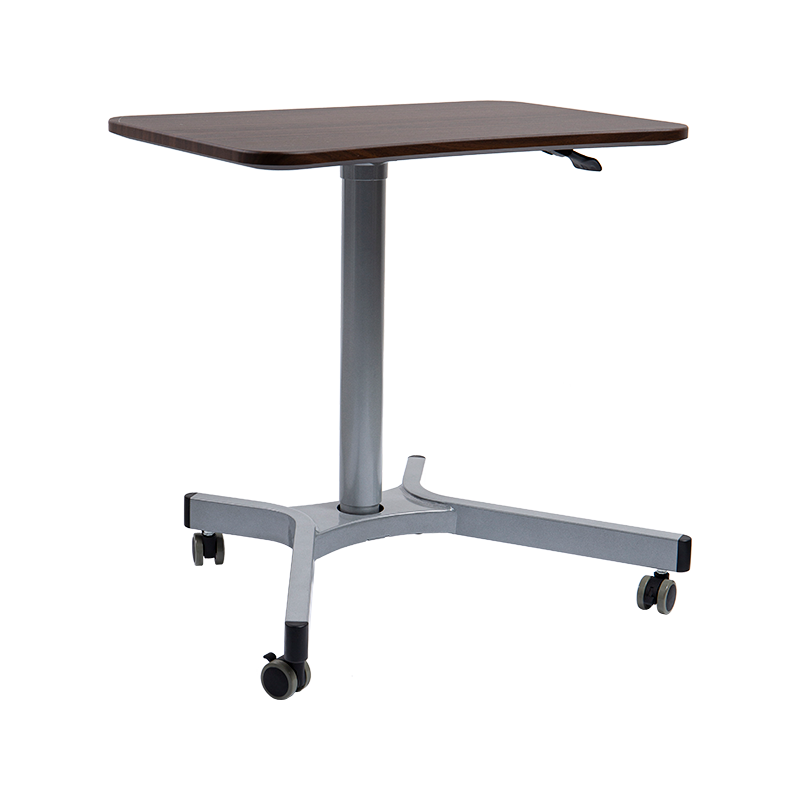
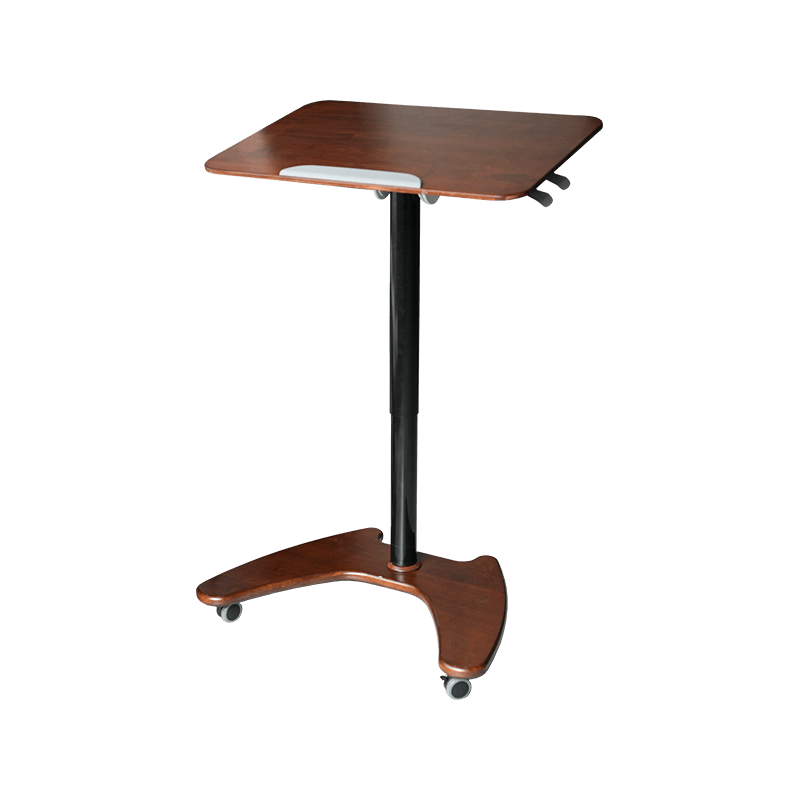
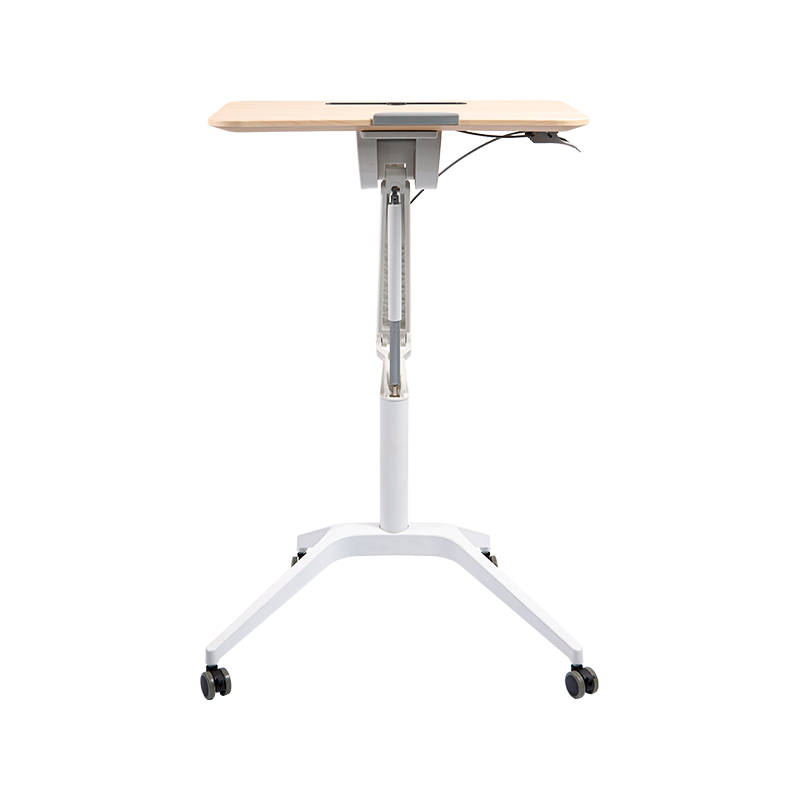
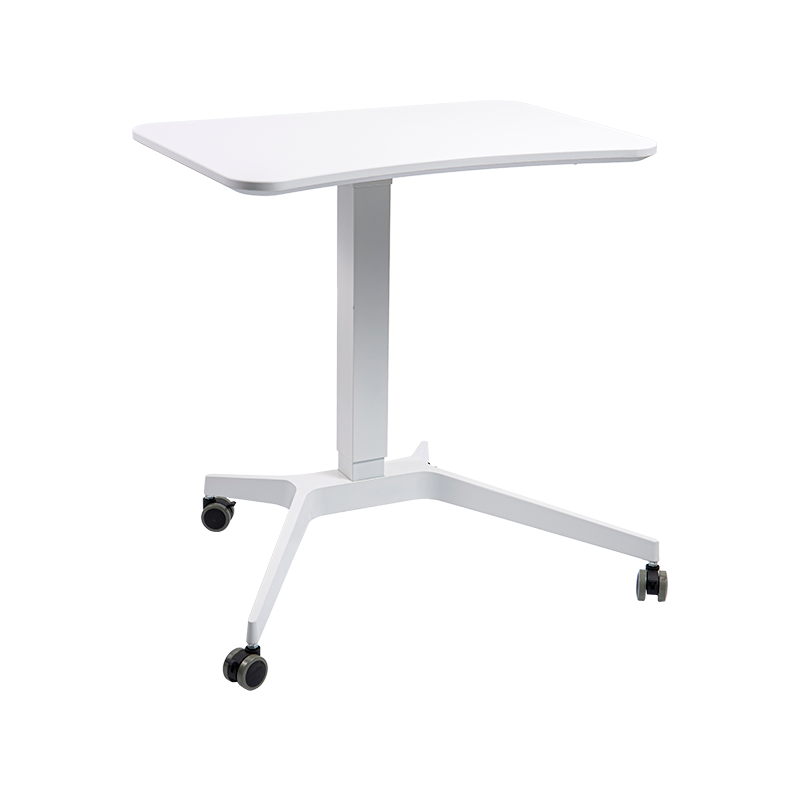
A pneumatic height-adjustable table uses a gas spring (or a pneumatic column, which works on the same principle) to support the tabletop's weight. When you release the tension holding the desk at a particular height and apply a small amount of force, the gas spring extends or contracts to move the tabletop up or down. Most pneumatic desk designs use a lever or paddle mechanism that you actuate with one hand while guiding the desk surface with the other. There's no motor, no electrical connection, and no power supply required.
The gas spring inside a pneumatic desk works by storing energy in compressed nitrogen gas. The spring is pre-loaded to approximately balance the weight of the tabletop at a neutral position, so you're not fighting the full weight of the surface when you adjust — you're only providing the small directional force needed to overcome the gas spring's preset balance point. This is why pneumatic desks feel light and easy to adjust despite supporting a solid tabletop.
The Practical Differences That Matter
Adjustment Speed and Effort
Electric desks are slower to adjust — a typical electric desk moves at 25–40mm per second, meaning a full range adjustment from sitting to standing height (usually about 400–500mm of travel) takes 10–20 seconds. You press a button and wait. With a height memory preset, this is about as effortless as it gets, but it's not instant.
Pneumatic desks move faster — you can adjust through the same range in 3–5 seconds with light physical effort. For people who want to adjust height frequently, or who want the immediacy of adjusting at the moment they decide to switch positions rather than pressing a button and waiting, the pneumatic mechanism feels more responsive. The tradeoff is that it requires you to physically guide the desk surface, which some people find slightly awkward on the first few tries until the motion becomes habitual.
Height, Memory, and Precision
This is a meaningful advantage for electric desks. A good electric standing desk lets you program two to four height presets — one for your sitting position, one for your standing position, perhaps one for a collaborative height if others use the desk. You press one button, and the desk goes to exactly that height, every time, without you thinking about it. The digital display shows the current height to the nearest millimeter.
Pneumatic desks have no memory. You adjust to approximately where you want to be, guided by feel or by a height scale marked on the column. Getting back to the same height each time requires a bit more attention, and you'll likely land within a centimeter or two of your preferred height rather than exactly on it. For most people, this is fine — the ergonomic difference between your desk at 73cm and 74cm is negligible. But for people who are particular about their setup or who adjust multiple times per day, the preset system of electric desks is genuinely more convenient.
Load Capacity
Electric desks generally support higher loads. A quality two-motor electric desk frame typically rates at 80–120kg capacity, which handles even a heavily equipped workstation with monitors, docking station, and accessories without issue. Pneumatic desk designs are constrained by what the gas spring can balance — typically 15–30kg of desktop load, depending on the design. Adding a lot of monitor arms, ultrawide monitors, or heavy accessories to a pneumatic desk can take it outside the gas spring's balance range, making it harder to adjust and potentially causing the desk to drift at certain heights.
For a standard single-monitor workstation with a laptop or light accessories, pneumatic capacity is usually fine. For multi-monitor setups, high-end workstations, or any configuration with significant weight on the tabletop, an electric desk is the more appropriate specification.
Power Dependency
Electric desks need a power outlet. This is obvious but worth stating, because it affects where the desk can be placed and what happens if the power goes out or the power cable gets damaged. Most electric desks can't be adjusted at all without power — the motors don't turn manually. Some higher-end models have a manual override for emergencies, but it's usually slow and awkward.
Pneumatic desks work anywhere, with or without a power outlet or not. For a home office where the desk placement is fixed and power is always available, this doesn't matter much. For an office fitout with desks placed away from walls, for temporary workspaces, or for environments where cable management is genuinely challenging, the no-power requirement of a pneumatic desk simplifies the installation significantly.
Noise
Pneumatic desks are essentially silent. The gas spring mechanism makes no noise when adjusting. Electric desks produce motor noise during adjustment — most quality modern electric desk motors are described as "quiet" and typically measure 45–55 dB during operation, which is roughly the volume of a normal conversation. This is noticeable in a quiet home office or a library-quiet professional space, less so in a busy open-plan office where background noise is already significant.
Price
Pneumatic desks are generally less expensive than electric desks at equivalent quality levels. The absence of motors, control panels, and electrical systems reduces manufacturing complexity and component cost. For buyers who want the height-adjustability function without the full price of an electric desk, pneumatic represents good value — particularly for home office use where the load capacity and precision limitations are rarely constraints.
Side-by-Side Summary
| Electric Standing Desk | Pneumatic Standing Desk | |
|---|---|---|
| Adjustment mechanism | Electric motors via button press | Gas spring via manual lever/paddle |
| Adjustment speed | Slower — 10–20 seconds full range | Fast — 3–5 seconds full range |
| Effort required | None — button press only | Light physical guidance of the desktop |
| Height memory presets | Yes — 2–4 programmable positions | No — manual adjustment to approximate height |
| Height accuracy | Exact — digital display, preset recall | Approximate — ±1–2cm of the target |
| Load capacity | High — typically 80–120kg | Moderate — typically 15–30kg |
| Power requirement | Requires a power outlet | No power required |
| Noise during adjustment | Audible motor noise (~45–55 dB) | Silent |
| Failure risk | Motor/electronics can fail; locked without power | Gas spring degrades slowly; very low failure rate |
| Typical price | Higher | Lower |
| Best suited for | Heavy workstations, frequent adjusters, multi-user desks | Light setups, power-independent locations, cost-sensitive buyers |
Which One Should You Get?
For most people, setting up a primary workstation with monitors and a reasonably equipped desktop, an electric desk is the better long-term choice. The height memory presets are a genuine quality-of-life feature that makes the sit-stand habit easier to maintain. The higher load capacity means you're not constrained in what you put on the desk. And as the primary desk in a dedicated home office or professional workspace, the power cable isn't a meaningful limitation.
A pneumatic desk makes more sense when the installation location doesn't have convenient power access, when the setup is relatively light (laptop, single monitor, minimal accessories), when budget is a constraint, or when silent operation in a shared space is important. For a dedicated focus workspace in a shared apartment, a conference room desk, or a secondary workstation that gets used occasionally, the pneumatic option's simplicity and lower price are practical advantages.
One scenario where pneumatic desks have a clear edge over budget electric desks: reliability. A low-cost electric desk's motors and control electronics are the components most likely to fail, and when they do, the desk is stuck at one height until it's repaired or replaced. A pneumatic desk has one main mechanical component — the gas spring — that degrades very slowly over many thousands of cycles and gives a warning before it fails. For installations where reliable operation over years without maintenance is a priority, the mechanical simplicity of pneumatic systems is genuinely an advantage over electric.
Frequently Asked Questions
Can a pneumatic standing desk hold dual monitors?
It depends on the specific desk's load rating and how the monitors are mounted. Two monitors on monitor arms can easily total 15–20kg, including the arms themselves, which approaches or exceeds the load range of lighter pneumatic desk designs. Check the manufacturer's specified load capacity for the pneumatic column — if your planned setup is near the limit, an electric desk is the safer choice. If you're using a single monitor or a lightweight dual setup with light monitors, most pneumatic desks handle it fine.
How long does a gas spring last in a pneumatic desk?
Quality gas springs in pneumatic desks are rated for 10,000–50,000 adjustment cycles, depending on the design and manufacturer. At ten adjustments per day (a generous usage pattern), 10,000 cycles is about 2.7 years; 50,000 cycles is over 13 years. In practice, most pneumatic desks see far fewer than ten full-range adjustments per day, so the gas spring lifespan is typically well beyond the rest of the desk's useful life. Signs that a gas spring is wearing out include the desk drifting down slowly when released, requiring more effort to adjust, or difficulty staying at a set height. Gas spring replacement is possible, but it typically requires the desk to go back to a service center.
Do electric standing desks need special wiring?
No — standard electric standing desks run on standard household current (110V in North America, 220–240V in Europe and most of Asia) and plug into a standard wall outlet. No special wiring, dedicated circuit, or electrician is required. The power draw during adjustment is modest (typically 200–400W during motor operation, zero at standstill), so there's no concern about overloading standard circuits. Cable management — routing the power cable and desk cables so they don't create a tripping hazard or get caught in the adjustment mechanism — is the main electrical consideration during installation.
Electric Height-Adjustable Desk | Pneumatic Height-Adjustable Table | Gas Springs | Get a Quote


- Contact Info
-
-
 Phone+86-15950656125
 -
 Email
Email -
 AddressRoom 1007-1, South Building, Suyue Plaza, Suzhou Industrial Park, Suzhou City, Jiangsu Province, China
-
- Products
- Follow Us
- Need help? Please contact us
Copyright ©
SuZhou Skyhone Intelligent Technology Co., Ltd.
All Rights Reserved.
Privacy
Custom Ergonomic Adjustable Office Tables Manufacturers

