

 English
 русский
 Español
 عربى

Content
- 1 Centric vs. Eccentric Pneumatic Desk: What the Geometry Means
- 2 Stability and Load Balance in Centric vs. Eccentric Pneumatic Desk Frames
- 3 Leg Room, Safety Clearance, and Floor-Plan Fit
- 4 Choosing Between a Centric and an Eccentric Pneumatic Desk
- 5 Quality Signals to Verify Before You Order Lift Columns
- 6 Frequently Asked Questions
Centric vs Eccentric Pneumatic Desk: Which Design Fits Your Space Better
2026-10-13
When a distributor in Europe ordered twelve pneumatic sit-stand workstations last quarter, the quote arrived with two floor-plan options: the SK02 with an offset gas-spring column and a 715×495 mm top, and the SK03 with the column mounted at the center of a 650×480 mm desktop. Both desks adjust without electricity — the SK02 from 665 to 1015 mm and the SK03 from 745 to 1060 mm — but the geometry changes leg room, torsional stiffness, and how each frame behaves under a leaning load at standing height. This guide compares centric vs. eccentric pneumatic desk construction against the measurements that actually matter in an office plan.
Centric vs. Eccentric Pneumatic Desk: What the Geometry Means
The difference is the position of the gas-spring column relative to the desktop. A centric pneumatic desk places the column directly beneath the geometric center of the tabletop, so the weight of the desk and everything on it transfers straight down into the column and base. An eccentric pneumatic desk shifts that column toward the rear edge or one corner, keeping the front-center area open so a user can pull a chair close and work without hitting the lift tube.
The lifting mechanism works the same way in both layouts. A hand lever releases a locking valve, the gas spring extends to push the desktop up, and closing the valve locks the height. No motor, no cable, and no power supply, which is why pneumatic height-adjustable desks are common in open-plan offices where running electricity to every station is expensive.
Core distinction
Centric means the lift column is centered under the desktop; eccentric means the column is offset toward one side. The offset design trades a small amount of structural symmetry for substantially more leg clearance.
The SK03 is the center-mounted reference model in this product family — a 650×480 mm top with a 745–1060 mm lift range — while the SK02 uses an eccentric layout with a 715×495 mm top and a 665–1015 mm range. Both adjust without electricity, so the decision comes down to ergonomics and stability, not to how the desk is powered.
Stability and Load Balance in Centric vs. Eccentric Pneumatic Desk Frames
For heavy payloads and repeated lifting to standing height, the centric design is structurally stiffer. Because the column sits on the load axis, bending forces spread evenly across the frame, and the desk resists front-edge wobble at full extension. This is the main reason the SK03 is specified when users lean on the desktop while presenting or reading at standing height.
The eccentric design concentrates the column at the rear, which forces the desktop to act as a lever arm under front-edge loads. A well-built eccentric desk compensates with a thicker steel spine and a wider base, so the offset costs noticeable rigidity only above roughly 100 cm with a sustained load. Below that point, most users cannot feel the difference.
At 100 cm lift height with a sustained payload, the centric frame typically shows less front-edge deflection than the offset frame; the gap narrows at lower settings.
| Characteristic | Centric (SK03) | Eccentric (SK02) |
| Column position | Center of desktop | Offset toward rear edge |
| Lift range | 745–1060 mm | 665–1015 mm |
| Desktop size | 650×480 mm | 715×495 mm |
| Front-edge deflection at high lift, sustained load | Low, short lever arm | Higher, frame must compensate |
| Leg clearance at front-center | Restricted by column | Open and unobstructed |
Relative structural profile of centric vs. eccentric pneumatic desk frames
Centric (SK03)
Eccentric (SK02)
Relative ratings for typical single-column pneumatic desk frames; higher means better for that characteristic.
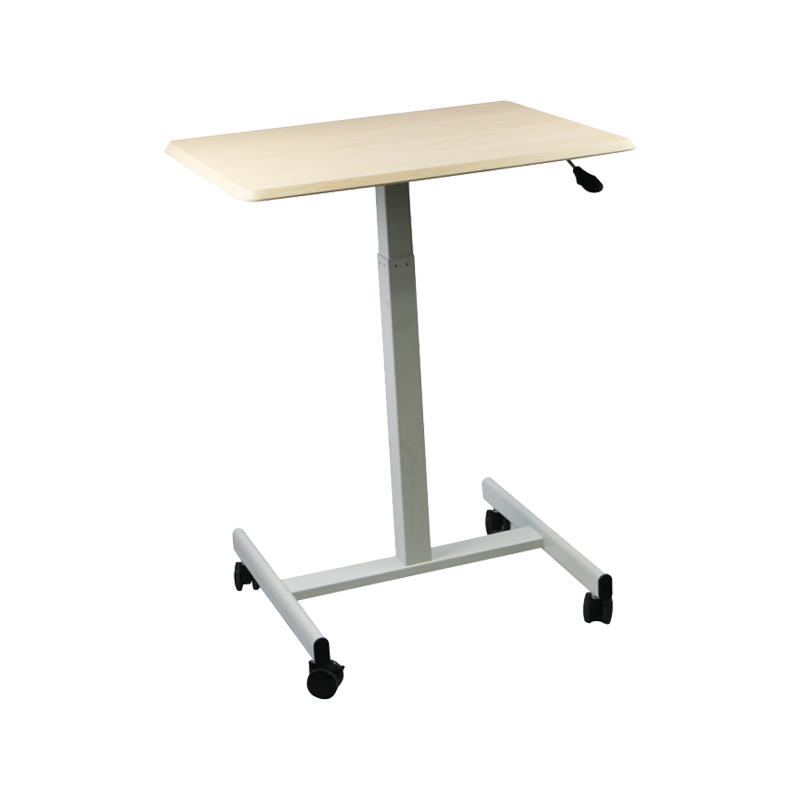 SK03 Center-Mounted Pneumatic Height-Adjustable DeskThis center-mounted desk offers a compact footprint for narrow spaces, with a 650×480 mm top, a gas spring lift from 745 to 1060 mm, and lockable casters. Its stable column design suits row layouts and fixed workstations.View Product →
Leg Room, Safety Clearance, and Floor-Plan Fit
The eccentric design wins decisively on user leg room. With the column at the rear, a user can sit with knees centered, stretch both legs under the desk, or swivel the chair without contacting the lift tube. That is why the SK02 is frequently specified for drafting stations and institutional offices where people sit for four or more consecutive working hours.
The centric design wins on footprint efficiency. Because there is no offset counterweight moment, the base can be narrower and the desk can sit closer to a wall while the column rises without interference. For compact desktops arranged in rows, the SK03 fits more stations into the same linear footage.
Eccentric layout suits spaces where
- Users write, draw, or type with knees centered under the desk
- Chairs with armrests are used at standing height
- Desks are deep enough to give the offset column room to work
Centric layout suits spaces where
- Desks use a compact top where footprint efficiency matters
- Rated payload matters more than leg freedom
- Rows of identical workstations share one layout
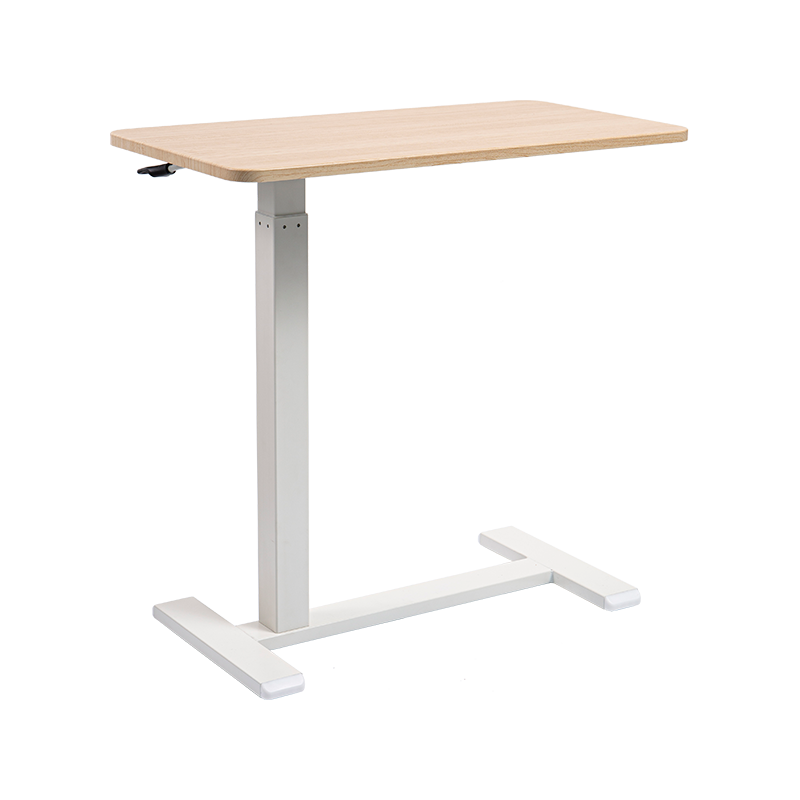 SK02 Eccentric Pneumatic Height-Adjustable DeskFeaturing a rear column for unobstructed legroom, this eccentric desk has a 715×495 mm top and adjusts from 665 to 1015 mm via gas lift. Its design supports long sitting sessions, ideal for drafting stations and institutional workstations.View Product →
Choosing Between a Centric and an Eccentric Pneumatic Desk
Match the lift geometry to the task zone before you match the budget. Run a simple test with a representative user: sit at the desk, place both hands on the surface, and check whether the knees stay centered without hitting the column. If the answer is no, the eccentric model removes the obstruction; if the answer is yes, the centric model delivers more stable standing behavior for the same money.
- Map the task zone: drawing at the front edge, typing at the center, or reading across the full width.
- Confirm the height range covers your users; the SK02 spans 665–1015 mm and the SK03 spans 745–1060 mm, covering most statures from the 5th percentile female to the 95th percentile male.
- Audit the payload: monitor arms, laptop stands, and paper files add weight on top of the desktop, so verify the rated load with the supplier at the maximum height.
- Measure the floor plan and allow rear clearance for the offset column travel.
- Verify the gas spring duty cycle and column finish on a sample unit before mass order.
This process also protects the procurement team: it turns a subjective preference into a documented layout requirement that can be checked against the sample unit before a full container order.
Quality Signals to Verify Before You Order Lift Columns
Pneumatic desk failures are almost always gas spring leaks or column wear, not structural breaks. A gas spring loses pressure gradually, so the desktop starts to sink at the top of its travel within the first year if the seal is poor. That is why the manufacturer engineering claims matter: SuZhou Skyhone Intelligent Technology Co., Ltd. states that its desk frames pass ISO environmental certification and ergonomic testing, and it builds the columns with a triangular mechanical structure intended to reduce lateral play.
- Ask for the gas spring brand and its declared charge pressure.
- Check the column wall finish; powder-coated steel resists scratches better than bare aluminum.
- Test the locking valve: the desk should hold position at any height, not only at set stops.
- Request a documented cycle count from the supplier before placing a bulk order.
- Run a load test at the highest setting before committing to a full container order.
665–1015 mm (SK02) / 745–1060 mm (SK03)
continuous height range across the SK02 and SK03 columns, no electric motor required
Both the SK02 and SK03 use a continuous mechanical range, which makes them suitable for sit-stand rotation without plugging into a power source. For a company sourcing multiple stations, that eliminates the cost of under-desk cabling and transformer units.
Practical verdict
If your users type or draw with knees centered and the desk offers enough depth, choose the eccentric SK02. If the layout is shallow, the payload is heavy, or the desks stand in identical rows, the centric SK03 is the more stable call.
For importers, distributors, and project buyers sourcing pneumatic sit-stand workstations in volume, request the column load rating at maximum height, the gas spring cycle count, and the floor-plan clearance data in writing before placing a container order. SuZhou Skyhone Intelligent Technology Co., Ltd. supplies both the center-mounted SK03 and the eccentric SK02 from one ISO-certified production base.
Frequently Asked Questions
Which is more stable, a centric or an eccentric pneumatic desk?
A centric design is more stable under front-edge loads because the column sits on the same vertical axis as the desktop center. An eccentric design can reach a similar level if the frame uses a thicker steel spine, but at the upper end of the height range the offset layout will always show slightly more movement under heavy load.
Is a pneumatic desk better for a compact institutional workstation?
Yes. A pneumatic desk needs no motor or control box, so nothing clutters the under-desk area, and the gas spring column requires very little floor space. Choose an eccentric layout when you need knee freedom, or a centric layout when the desk is shallow and the payload is the priority.
How much weight can a pneumatic sit-stand desk hold?
Load capacity depends on the gas spring charge and column construction, so verify the rated load with the supplier at the maximum height, where lifting capacity is lowest.
How long does a gas spring desk last?
Service life depends on the seal and gas charge quality. Ask the manufacturer for the tested cycle rating, and confirm the spring cartridge can be replaced without replacing the whole frame.





- Contact Info
-
-
 Phone+86-15950656125
-
 Email
-
 AddressRoom 1007-1, South Building, Suyue Plaza, Suzhou Industrial Park, Suzhou City, Jiangsu Province, China
-
- Products
- Follow Us
- Need help? Please contact us
Copyright ©
SuZhou Skyhone Intelligent Technology Co., Ltd.
All Rights Reserved.
Privacy
Custom Ergonomic Adjustable Office Tables Manufacturers

