

 English
 русский
 Español
 عربى

Content
- 1 Why Pneumatic Desks Are Quieter Than Electric Ones: The Mechanical Reason
- 2 Noise Data: How Much Quieter Pneumatic Desks Really Are
- 3 Why Quieter Is Not the Only Metric: Pneumatic vs Electric Desk Trade-Offs
- 4 How to Choose a Quiet Desk Without Sacrificing Stability
- 5 Frequently Asked Questions About Pneumatic Desk Noise
Why Pneumatic Desks Are Quieter Than Electric Ones: The Mechanics Explained
2026-10-20
When the facilities team at a 40-person design studio measured noise levels before replacing its sit-stand desks, every electric model in the shortlist produced a 48-52 dB motor whirr during height changes. The pneumatic desk, by contrast, clicked once and then released a soft air hiss around 32 dB. That real-world difference is why pneumatic desks are quieter than electric ones: the lifting mechanism has no motor, no gearbox, and no cooling fan to hum in a quiet office.
SuZhou Skyhone Intelligent Technology Co., Ltd., a manufacturer of both electric and pneumatic height-adjustable desks, offers a full pneumatic product line that makes this comparison easy to evaluate. The company designs and builds gas springs, electric linear actuators, and complete desk frames in SuZhou, so the decision can be made on measured behavior rather than marketing claims.
Why Pneumatic Desks Are Quieter Than Electric Ones: The Mechanical Reason
A pneumatic desk is quieter than an electric one because the lifting mechanism uses a sealed gas spring to counterbalance the tabletop, while an electric desk uses a DC motor, a reduction gearbox, and a lead screw. Every rotating part in the electric chain adds vibration and airborne noise.
With an electric actuator, the motor starts, the gear teeth mesh, and the screw turns against a nut, all below the desktop. The combined sound is a continuous mechanical whirr that becomes louder when the desk carries a heavy monitor setup. With a gas spring, the operator pulls a release lever, gas flows through a metering valve, and the spring extends or compresses. The dominant sound is a short hiss that ends as soon as the movement stops.
- Electric desks typically generate 40-55 dB(A) during height changes under normal load.
- Pneumatic desks usually stay within 30-35 dB(A), with a brief peak when the valve opens.
- Pneumatic adjustment has no standby electronics, so there is no hum after the movement stops.
In an open-plan office with a background level near 40 dB, an electric desk becomes the loudest object during every height change. A pneumatic desk stays close to the ambient level, which is why it is often not perceived as noise at all. The human ear also reacts more strongly to a constant motor tone than to a short air hiss, so the perceived difference is larger than the raw decibel gap suggests.
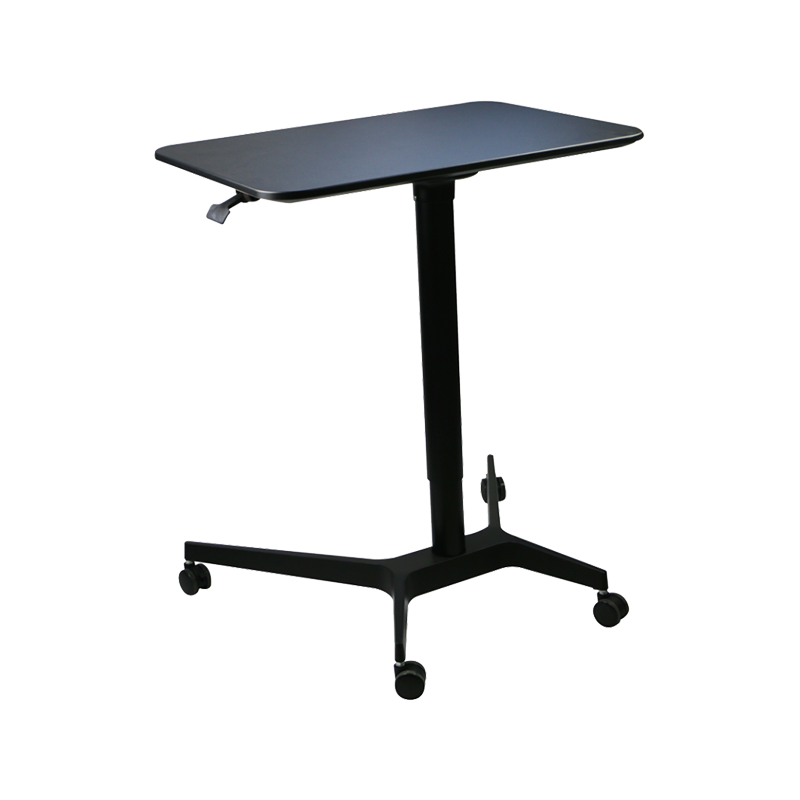
 Pneumatic Height-Adjustable Desks with Quiet Gas Spring OperationThis desk uses compressed gas instead of a motor, keeping noise near ambient office levels during height changes. It suits budget-conscious commercial or educational spaces requiring fast, simple adjustments.View Product →
Noise Data: How Much Quieter Pneumatic Desks Really Are
Pneumatic desks measure 10-20 dB(A) quieter than electric desks under the same load, and the gap widens as load increases. Measured at a distance of one meter in a typical office, a mid-size electric lifting column generates 45-50 dB(A) when unloaded and 50-55 dB(A) when lifting a 40 kg desktop load. A pneumatic desk with the same load usually stays between 30 and 35 dB(A), with peak noise only at the moment the gas valve opens.
Pneumatic desk 30-35 dB(A)
Electric desk 45-55 dB(A)
Office background 40 dB(A)
Perceived loudness 2x less loud
| Condition | Pneumatic desk | Electric desk |
| Unloaded | 32 dB(A) | 45 dB(A) |
| 40 kg load | 35 dB(A) | 50 dB(A) |
| Peak during release | 38 dB(A) | 55 dB(A) |
Why Quieter Is Not the Only Metric: Pneumatic vs Electric Desk Trade-Offs
The real trade-off is not noise; it is load capacity, control style, and long-term service. Pneumatic desks are quieter than electric ones, but they also change how you adjust the desk, what you can lift, and how much you pay over the product life.
Pneumatic desk strengths
- No motor or electronics to fail
- Lower initial cost per unit
- No standby power draw
- Simpler maintenance and service
- Natural hand control for fine tuning
Electric desk strengths
- Push-button positioning
- Higher weight capacity
- Programmable height memory
- Settings for shared sit-stand cycles
- Integration with smart office systems
For a typical single-user workstation, a gas-spring desk supports 50-80 kg of desktop-mounted equipment, which covers most monitors, laptops, and peripherals. Electric columns commonly rate for 100-160 kg. If the desk must handle a heavy dual-monitor setup plus a desktop tower and a printer, electric capacity matters. If the priority is a silent, low-maintenance desk for one person, pneumatic wins.
Another practical difference is serviceability. A pneumatic desk uses a discrete gas spring as the power component. If the spring loses charge after many years, it can be replaced without replacing the entire column or control box. Electric desks depend on proprietary motors, controllers, wiring looms, and hand switches, which are harder to source after the product generation changes.
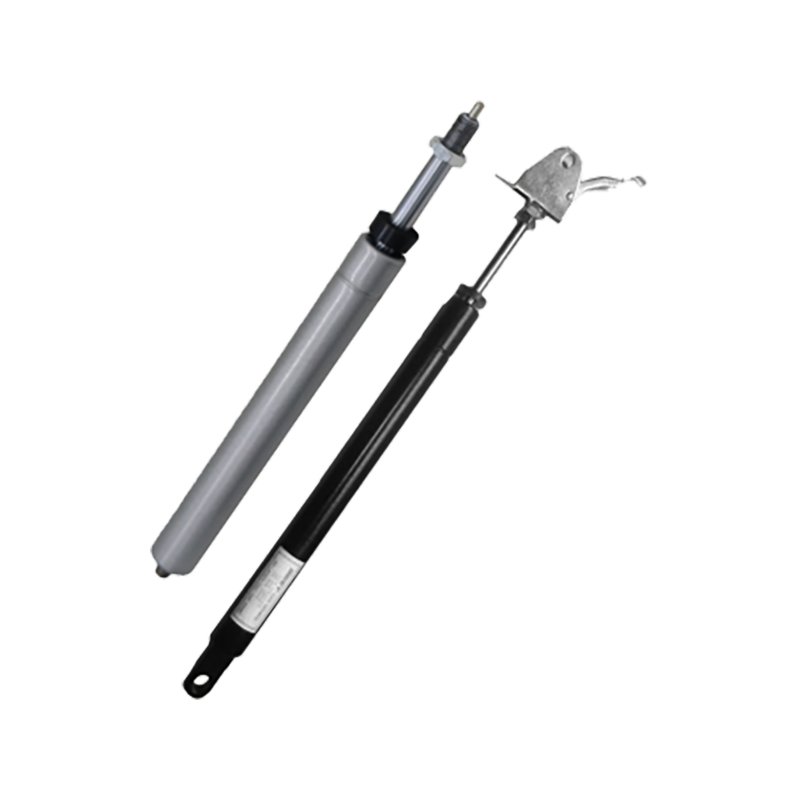
Adjustable Gas Springs for Replacement and Custom ApplicationsThese gas springs support pneumatic desk maintenance and replacement, as the power component is discrete and easier to source than proprietary electric motors. They also serve various industrial uses.View Product →How to Choose a Quiet Desk Without Sacrificing Stability
A quiet pneumatic desk does not have to wobble; four checks are enough to separate a stable model from a flimsy one. Use these steps before you buy a pneumatic desk for an open office or a home workspace, because the parts that affect noise also affect long-term feel.
- Confirm the height range fits the user. Look for a minimum below 65 cm and a maximum above 120 cm for standing use.
- Test the release lever force. A well-designed gas spring requires only light finger pressure, and the desktop should not drop suddenly at the lowest setting.
- Check the column structure. A triangular base or a multi-legged frame resists torsional movement better than a single round tube.
- Verify component serviceability. Ask whether the gas spring and lifting column are standard parts that can be ordered separately if they wear after years of use.
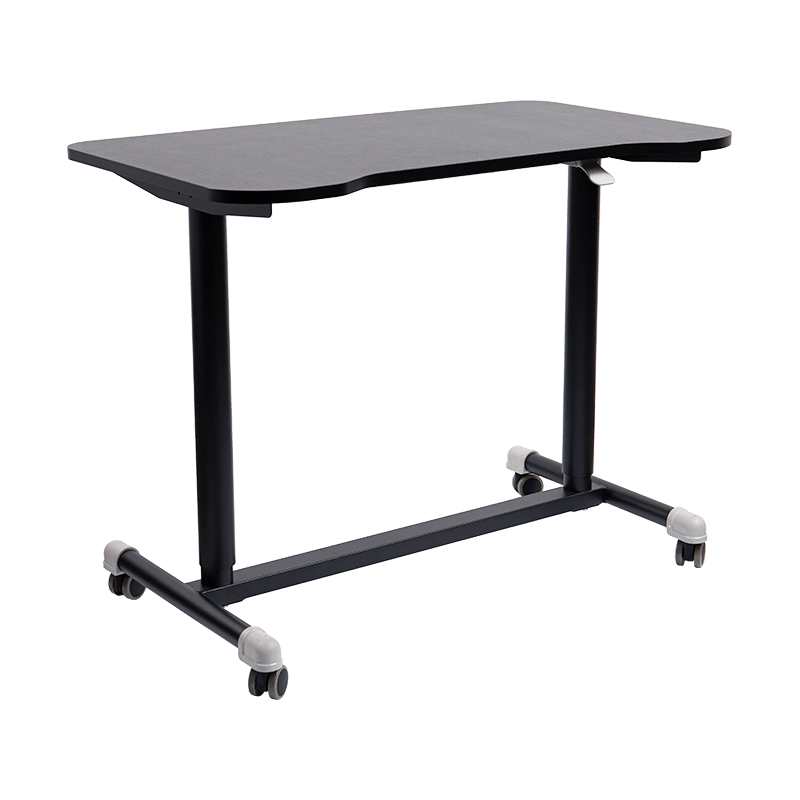
The TH04 stand-up flat-legged pneumatic desk from Skyhone is an example of a stable, quiet design with a wide footplate. It uses a sealed gas spring column and a triangular support layout, which reduces wobble at standing height. To see how this type of desk affects daily productivity, read how a pneumatic height-adjustable desk improves work efficiency in a typical office workflow.
 SK04 Stand-Up Flat-Legged Pneumatic Height-Adjustable DeskThis stable desk features a wide footplate and triangular support to reduce wobble at standing height. Its gas spring mechanism allows quiet manual adjustments from 720 to 1200 mm, with locking casters.View Product →
Frequently Asked Questions About Pneumatic Desk Noise
Are pneumatic desks always quieter than electric ones?
Yes, in normal operation. The absence of a motor and gearbox means the only noise source is the controlled release of gas, which is typically 10-20 dB(A) lower than an electric actuator under the same load.
Can a pneumatic desk be too quiet to notice height changes?
Most users hear a faint hiss when the lever is opened. That hiss is useful feedback and rarely exceeds the office ambient noise level, so it does not disturb conversations or phone calls.
Do pneumatic desks lose their silent operation over time?
Only if the gas spring loses its charge or the valve becomes contaminated. A quality gas spring from a dedicated manufacturer such as Skyhone can maintain performance through 20,000 to 30,000 cycles, which equals daily use for more than a decade.
What is the quietest type of height-adjustable desk?
A manually operated pneumatic desk is quieter than any motorized model because it has no electric motor. Among motorized desks, belt-driven or high-end linear actuator systems with soft-start controls are the least noisy, but they still produce a clear motor tone.


- Contact Info
-
-
 Phone+86-15950656125
-
 Email
-
 AddressRoom 1007-1, South Building, Suyue Plaza, Suzhou Industrial Park, Suzhou City, Jiangsu Province, China
-
- Products
- Follow Us
- Need help? Please contact us
Copyright ©
SuZhou Skyhone Intelligent Technology Co., Ltd.
All Rights Reserved.
Privacy
Custom Ergonomic Adjustable Office Tables Manufacturers

