

 English
 русский
 Español
 عربى

Content
- 1 Why mechanical pneumatic systems are moving back into industrial design
- 2 What a gas spring does that a motorized actuator cannot
- 3 Where motorized actuation still wins the specification
- 4 Pneumatic versus motorized: the criteria that decide a project
- 5 Frame details that decide whether a pneumatic workstation feels solid
- 6 A procurement checklist for mechanical pneumatic systems
- 7 What the shift means for the next product cycle
- 8 Frequently asked questions
Why Industrial Design Is Moving Back to: Practical Applications, Selection, Performance
2026-11-10
A pneumatic lift column holds its height with no motor, no battery and no control board. That single property explains a reversal now visible on specification sheets for office furniture, medical carts and vehicle tailgates: mechanical pneumatic systems are returning to the center of the design brief after a decade in the spare-parts column. The driver is not nostalgia. It is cost of ownership, serviceability and physics, because a gas spring stores energy inside a sealed cylinder while a motorized actuator has to convert it twice before anything moves.
Why mechanical pneumatic systems are moving back into industrial design
Mechanical pneumatic systems are returning because they deliver the same visible function as motorized actuation with fewer failure points, no standby power and a bill of materials that stays cheap to certify.
Three forces push the decision. The first is compliance load. Every motorized frame carries a control box, a power supply, a wiring harness and firmware, and each of those adds a certification file, a spare-part number and a warranty exposure. A pneumatic column carries none of them.
- Service economics: a gas spring is a line-replaceable part held by two pins, so a technician swaps it in about ten minutes with hand tools. A failed control board usually sends the whole frame back to the factory.
- Energy accounting: a motorized desk frame draws roughly 0.05 to 0.1 Wh per adjustment plus standby draw. That is trivial for one desk and measurable across a 500-desk floor making eight adjustments a day.
- Material streams: steel, aluminum, nitrogen and a small oil charge already have recycling routes, and there is no lithium cell to declare at end of life.
- Failure behavior: when a gas spring loses charge the column sinks slowly and predictably; when a controller fails, the desk stops wherever it happens to stand.
What a gas spring does that a motorized actuator cannot
A gas spring turns stored pressure into a nearly constant lifting force, which means a pneumatic column can hold a load with no powered control loop at all.
Definition
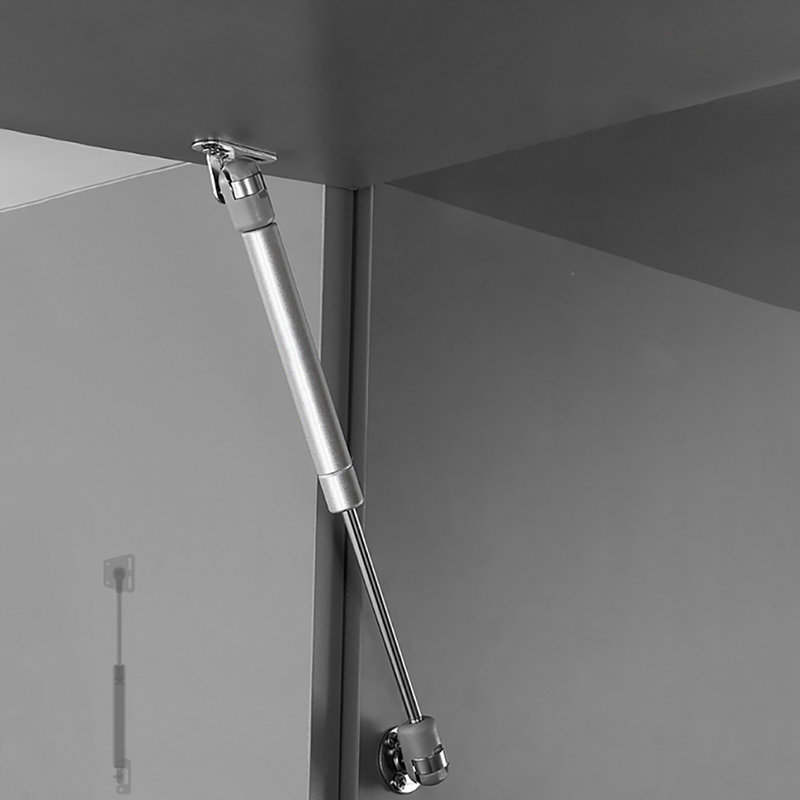
A gas spring is a sealed cylinder filled with compressed nitrogen that pushes against a piston rod. Output force equals charge pressure multiplied by piston area, and a release valve lets the operator lock or release the column anywhere in its stroke.
Because force is set at fill time rather than commanded by software, behavior does not drift with a firmware update or a sensor recalibration. Workstation columns are typically charged to a few tens of bar and fitted with an oil bypass so the lift is damped instead of snappy, which is what makes a pneumatic desk feel controlled rather than springy.
The mechanical layout also stays simple. Height range is set by column overlap and gas spring stroke, not by motor torque or screw pitch. For instance, SuZhou Skyhone manufactures pneumatic models with varied ranges—such as 665–1015 mm for compact desks and up to 1200 mm for tall standing frames. There is no holding brake to size and no cable to route through a moving leg.
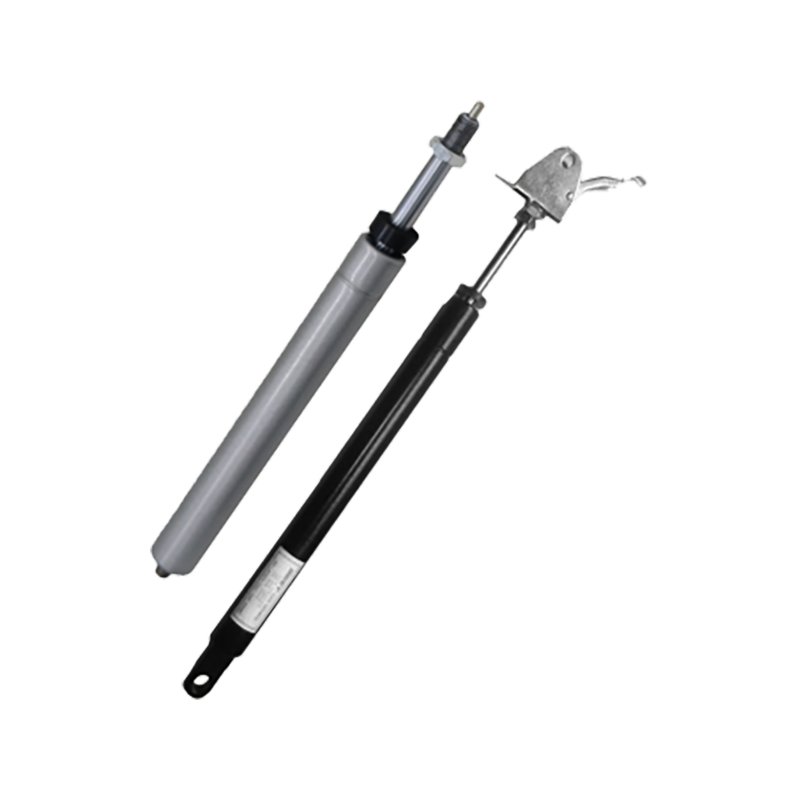 Custom Adjustable Gas Springs for Height AdjustmentBrowse lockable, standard free-type, and free-stop gas spring options for furniture height adjustment, with details for each type and custom supply.View Product →
The trade-off is fixed force. A spring tuned for a 70 kg load feels heavy under a 40 kg bench and weak under a 110 kg one, so charge pressure has to match the intended payload band before tooling is released.
Where motorized actuation still wins the specification
Motorized actuation still wins wherever the product needs programmable positions, memory presets, synchronized multi-column motion or force feedback, and no pneumatic design replaces those functions.
Pneumatic takes the lead when
- No power is available at the point of use
- The payload band is known and fixed
- The environment is dusty, wet or unheated
- The unit must survive years of unattended use
- Unit cost has to hold at volume
Motorized takes the lead when
- Users store and recall height presets
- The product links to apps or building systems
- Payloads exceed roughly 120 kg
- Position must repeat to the millimeter
- Anti-collision sensing is required
In practice most catalogs end up carrying both, and the split follows the duty cycle. A meeting room that adjusts twice a day is a pneumatic application; a 24-hour control room with shift-based height changes and booking-system integration is a motorized one.
Pneumatic versus motorized: the criteria that decide a project
On the five criteria that dominate specification reviews, pneumatic systems lead on four and lose on one, control precision, which is why the decision usually turns on how the product is used rather than on headline performance.
Specifier score by criterion, 0 to 10
Energy independence
Payload per unit cost
Service simplicity
Control precision
Long-life reliability
Pneumatic Motorized
The scoring reflects behavior in service rather than first-demo performance. A pneumatic column loses points on precision because its stop position depends on the operator, while a motorized frame loses points on energy independence because nothing moves without a live circuit and a charged battery.
Where the two systems are close, the tie usually breaks on repair logistics. A single gas spring on a warehouse rack can be replaced from stock in minutes; a matched controller and handset pair has to ship as a unit.
Frame details that decide whether a pneumatic workstation feels solid
On a pneumatic desk the spring supplies force and nothing else; the feel comes from frame geometry, column overlap and how the load path reaches the floor.
665 to 1200 mmAvailable pneumatic height ranges
Sufficient overlapColumn engagement at lowest setting
0 WStandby draw while locked
- Column overlap: keep enough engagement at the lowest setting, or the frame racks under a lateral push.
- Bracing: a triangular brace between column and foot turns sideways force into compression, which is why three-claw and cat-head leg designs keep appearing across pneumatic ranges.
- Foot span: feet that are too short relative to the top width produce visible rock during normal typing load.
- Valve placement: the release lever should sit within easy reach of where the hand naturally lands while seated.
- Top thickness: 18 mm to 25 mm panels hold screw pull-out after two or three rework cycles; thinner tops do not.
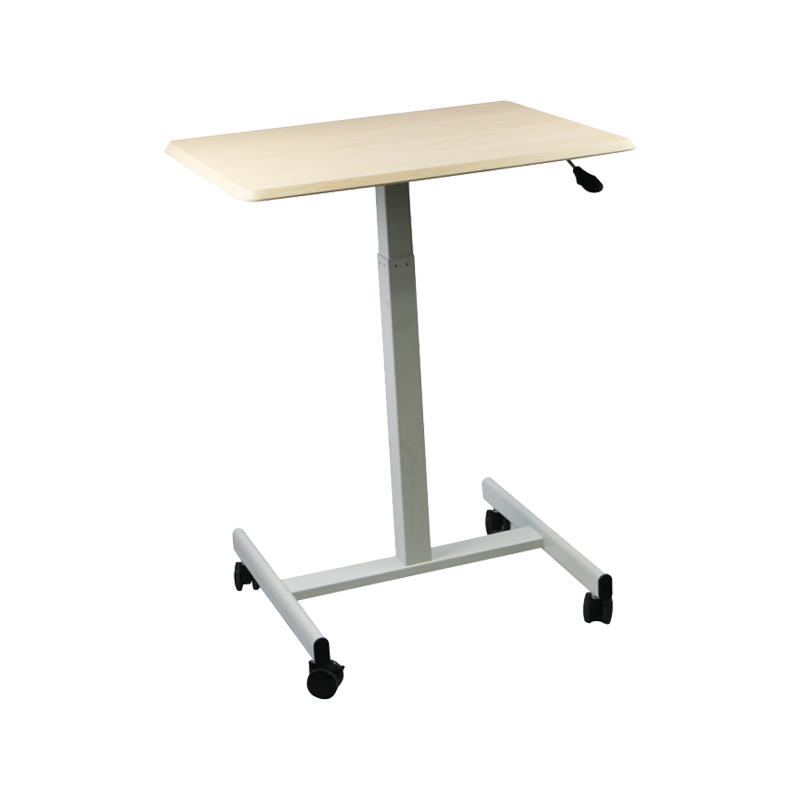 SK03 Center-Mounted Pneumatic Height-Adjustable DeskA gas-spring sit-stand desk with 745–1060 mm lift, 650 x 480 mm MDF top, powder-coated iron frame, and four cast wheels.View Product →
The productivity argument is well covered in this note on how a pneumatic height-adjustable desk improves work efficiency, and it holds up because the adjustment takes one hand and under two seconds.
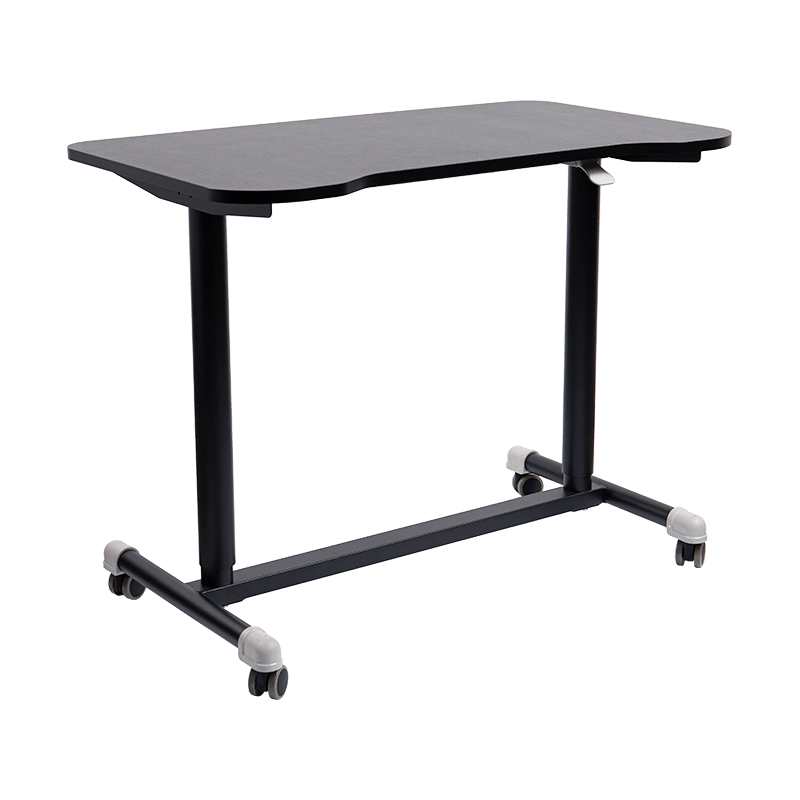 SK-14 Double-Leg Pneumatic Height-Adjustable DeskA gas-spring sit-stand desk with 760–1100 mm lift, 980 x 560 mm top, black powder-coated iron build, and locking casters.View Product →
A procurement checklist for mechanical pneumatic systems
Run every pneumatic lift through five checks before a sample is approved, because each one maps to a failure mode that surfaces inside the first two years.
| Check | Why it matters | Target answer |
| Force at full extension | A spring tuned at mid-stroke can overpower the top of the travel | Lifting force stays consistent across the stroke |
| Charge pressure tolerance | Nitrogen loss is the main long-term wear mechanism | Pressure holds after a 24-hour static test |
| Cycle rating | Duty claims vary widely between suppliers | Documented rating requested from the factory |
| Release valve type | Lever and trigger valves suit different hand positions | Valve reachable from a seated posture without leaning |
| Spare-part availability | A pneumatic system is only serviceable if the spring can be reordered | Spring listed as a separate orderable part with a published lead time |
The last row matters more than the first. A pneumatic desk that cannot get a replacement spring in year three becomes a motorized desk on the next purchase order.
What the shift means for the next product cycle
The return to mechanical pneumatic systems moves value away from firmware and app integration and toward frame stiffness, spring tuning and parts logistics.
For buyers, the specification conversation shifts to measurable mechanical properties such as height range, column overlap, payload band and service part availability, and away from feature lists.
The practical conclusion is short. If the product changes height a few times a day and the payload is known, a pneumatic column is the cheaper and more serviceable answer, and that is why it is back on the drawing board.
Frequently asked questions
Are pneumatic standing desks as stable as motorized ones?
Stability depends on the frame, not the drive. A pneumatic column with sufficient overlap, a triangular brace and a properly sized foot span is as rigid as a motorized frame of the same geometry; the spring changes how force is applied, not how the frame resists a sideways push.
How long does a gas spring last in a desk application?
A workstation gas spring rated for tens of thousands of cycles covers years of daily adjustments. Nitrogen loss is the main wear mechanism, and it shows up as a slow sink rather than a sudden failure, which makes replacement easy to schedule.
Do pneumatic systems need maintenance?
There is no lubrication schedule and no firmware to update. The practical list has two items: confirm the release valve returns fully after each adjustment, and confirm the spring part number is still stocked. Both take under a minute per unit.
Can a gas spring carry heavy loads such as monitor arms or equipment carts?
Yes, up to the force that piston area and charge pressure can generate. Workstation columns are usually tuned for standard office payloads; heavier equipment needs a larger bore cylinder and a higher charge pressure rather than a second spring.

- Contact Info
-
-
 Phone+86-15950656125
-
 Email
-
 AddressRoom 1007-1, South Building, Suyue Plaza, Suzhou Industrial Park, Suzhou City, Jiangsu Province, China
-
- Products
- Follow Us
- Need help? Please contact us
Copyright ©
SuZhou Skyhone Intelligent Technology Co., Ltd.
All Rights Reserved.
Privacy
Custom Ergonomic Adjustable Office Tables Manufacturers

